Kitchener - Waterloo - Cambridge - Guelph - Mississauga - Toronto
Posted on : Sunday September 6, 2026
How Weed Delivery Works in Kitchener-Waterloo
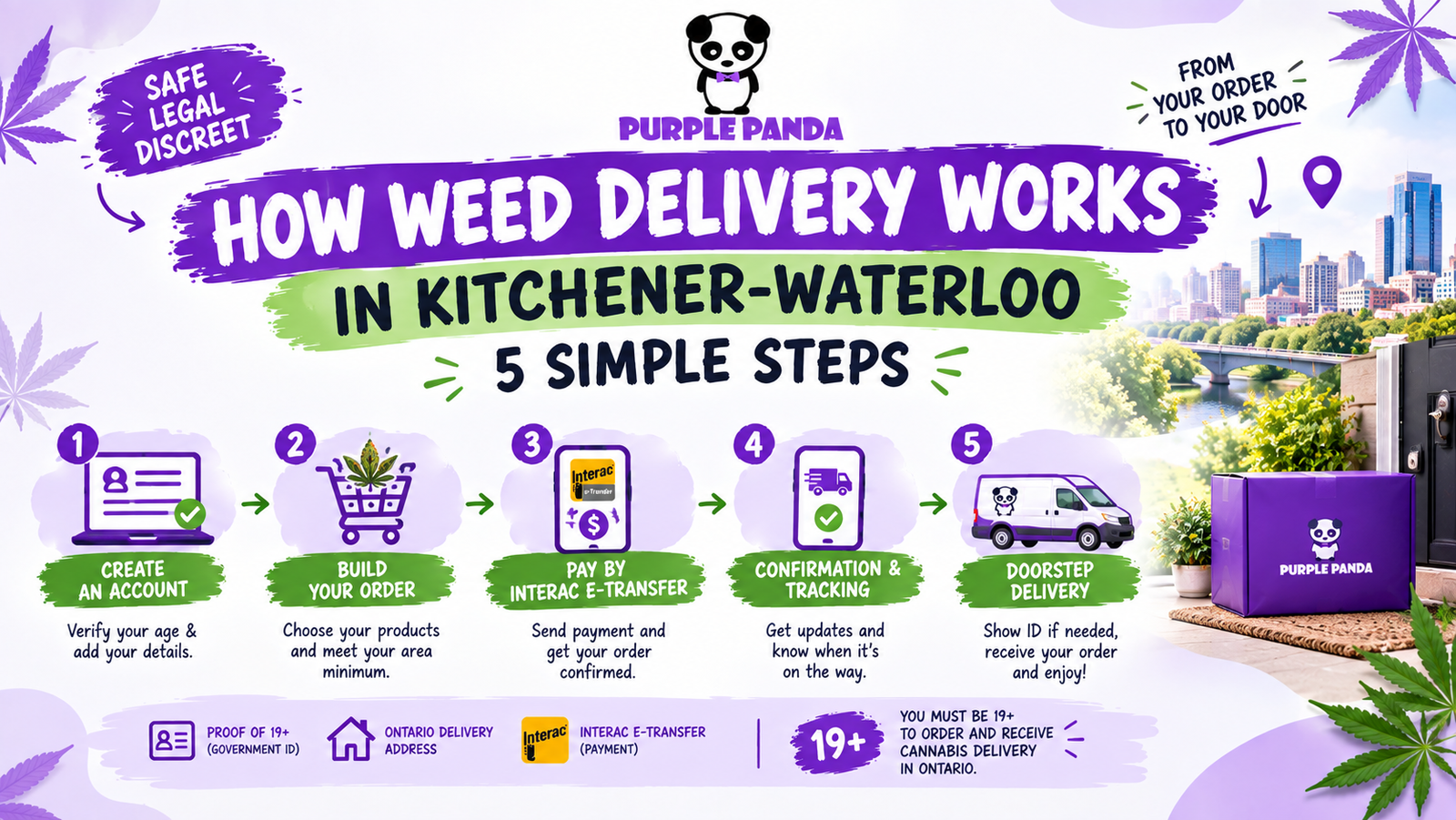
Ordering weed delivery is a five-step process, and knowing what happens at each step removes most of the guesswork for first-time buyers. Here's exactly what happens between clicking order and someone knocking on your door, plus the small details that actually decide whether it goes smoothly.
You must be 19+ to order and receive cannabis delivery in Ontario.
What You Need Before You Start
Three things, and nothing more:
- Proof you're 19+. A government-issued photo ID with your birth date on it, such as a driver's licence or passport.
- A delivery address in Ontario. Cannabis delivery can only go to a residence or private location, never a public place like a workplace or parking lot.
- A way to send an Interac e-Transfer. This is the standard payment method for legal cannabis delivery, covered fully in our e-Transfer guide and in Step 3 below.
Nothing else is required. There's no application, no waiting period, and no separate approval process beyond confirming your age.
Step 1: Create an Account
You'll set up an account with your name, delivery address and contact details. This is also typically where age is confirmed for the first time, before you're able to browse or check out.
It takes a few minutes and only needs doing once. After that, reordering is a matter of logging in and building a new cart, without repeating this step. Keep your delivery address current if you move, since an old address on file is one of the more common causes of a failed delivery.
Step 2: Build Your Order and Hit Your Area's Minimum
Add what you want to your cart. Most delivery services set a minimum order amount, and it varies by area, generally reflecting distance from where orders are dispatched. Check local delivery areas and order minimums in our Waterloo weed delivery guide, Waterloo stores, Guelph, and Cambridge for your specific location before you finalise your order, so you're not short at checkout.
If your first cart falls short of the minimum, it's usually cheaper to add one more small item than to place a second separate order later, since a second order means paying for delivery twice.
This is also the point where it's worth deciding what you actually want rather than just filling the cart. If you're unsure where to start, our guides on choosing between indica, sativa and hybrid and what the star ratings mean both cover what actually matters when you're picking, rather than just filling a cart to hit a number.
Step 3: Pay by Interac e-Transfer
Card payment isn't standard for legal cannabis delivery in Canada. Card networks and payment processors remain broadly cautious about cannabis transactions even where the product is fully legal, so Interac e-Transfer has become the default across the industry rather than a choice any single retailer makes on its own.
Sending one is straightforward if you've used online or mobile banking before. You'll need the recipient's email address or phone number, which is provided once your order is placed, and in some cases a security question and answer for the recipient to confirm the transfer. If the recipient has Autodeposit set up, that step is skipped and funds move automatically. Once sent, the recipient can typically see the funds within minutes, though this varies slightly by bank.
Delivery is dispatched once payment clears, so sending your e-Transfer promptly is the single biggest thing you control over how quickly your order moves. This is also why cash on delivery isn't standard for this category. A driver carrying product and collecting cash on the doorstep is a different risk profile than one confirming a payment that's already cleared, which is part of why the industry has settled on pay-first as the norm.
Step 4: Confirmation and Tracking
Once your e-Transfer is received, you'll get confirmation that your order is being prepared, usually by email or text. Most services then provide some form of order status or a way to reach the driver directly, rather than a live map. Ask what's available if it isn't clear.
Confirmation timing is worth paying attention to. If you haven't heard anything within a reasonable window after sending payment, that's the moment to follow up, rather than waiting and assuming it's in hand. A missed or misspelled email address on your account is a common, entirely avoidable reason confirmation doesn't arrive.
Step 5: The Delivery Itself
The driver arrives at the address on your order. If you look under 25, they're required to check government-issued ID before handing anything over, so have it ready. Someone 19+ needs to be present to receive the order and complete this check; it can't legally be left at the door unattended. If valid ID can't be produced when it's asked for, the delivery generally can't be completed at that visit.
Packaging gives nothing away. Health Canada requires cannabis packaging to be opaque, in a single plain colour, with no images, cut-out windows or branding beyond what's permitted, so there's nothing visibly identifiable from the outside. This is federal law that applies across every licensed cannabis product in Canada, not a courtesy specific to any one retailer.
The delivery itself is quick, generally a couple of minutes at the door: ID check if needed, order handed over, done. There's no parking-lot handoff and no meeting at a public location. It goes to the address on the order, and nowhere else.
What a Typical Order Looks Like, Start to Finish
Putting the five steps together, a straightforward order looks something like this. You create an account and confirm your age, which takes a few minutes the first time and nothing at all on future orders. You build a cart, checking it against your area's minimum, and browse by strain type or star grade if you're not sure what you want. You send an Interac e-Transfer to the details provided, which typically clears within minutes. You get confirmation that the order is being prepared, along with some way to check its status. The driver arrives at your address, checks ID if you look under 25, and hands over a plain, unmarked discreet package.
None of these steps require anything unusual on your part, and once you've placed one order, every future order is faster because your account and address are already set up.
How Long It Usually Takes
This depends on when you order and where you live. Ordering earlier in the day gives you the best chance of same-day delivery; check your retailer's current cut-off time, since this varies and can change. Orders placed after the cut-off typically go out the next business day rather than waiting until a later same-day window.
Weekday orders in areas close to the dispatch point tend to move fastest, since there's less distance to cover and less order volume competing for the same delivery window. Weekends and evenings, when order volume tends to be higher, can push same-day delivery closer to the cut-off, so ordering a little earlier than you think you need to is rarely wasted effort.
What Can Slow an Order Down
A handful of things account for most delays: an incomplete or unclear address, nobody available at the delivery address to show ID, payment sent later than expected, an order that falls short of your area's minimum, and simply ordering during a high-demand period. Getting the address and payment right the first time avoids nearly all of it.
An address that's easy to find matters more than people expect. A buzzer code, a unit number, or a note about which door to use saves a driver from circling a building, and that time adds up across a whole delivery run, not just your own order. The same logic applies to your account's contact details; an old phone number or a mistyped email can mean confirmation goes nowhere, and you're left wondering why nothing has moved.
Frequently Asked Questions
Do I need to be 19 to receive delivery, or just to order?
Both. Age is checked when you set up your account, and it's checked again at the door if you appear under 25. Someone under 19 cannot legally receive the order even if someone else placed it.
Can someone else accept my delivery for me?
Yes, as long as they're 19+ and can show ID if asked. The order still needs a legal-age adult present at the address, whether that's you or someone else.
Do I need to set up a security question for the e-Transfer?
Only if the recipient hasn't enabled Autodeposit, in which case a security question and answer confirms the transfer on their end. If Autodeposit is on, funds move automatically and no question is needed.
What if my e-Transfer doesn't go through right away?
Delivery is generally dispatched once payment clears, so a delayed transfer means a delayed order. If it's taking longer than expected, contact your retailer directly rather than assuming it's been received.
What happens if I can't show ID at the door?
The driver can't complete the delivery without confirming you're 19 or older if you appear under 25. Keep your ID somewhere accessible before the driver is due, rather than searching for it once they've arrived.
Can delivery come to my workplace or a parking lot?
No. Cannabis delivery in Ontario can only go to a residence or private location, not a public place. This applies across the industry, not just to any one retailer.
Ready? Explore our full product catalog and check your area's minimum.