Kitchener - Waterloo - Cambridge - Guelph - Mississauga - Toronto
Posted on : Monday August 31, 2026
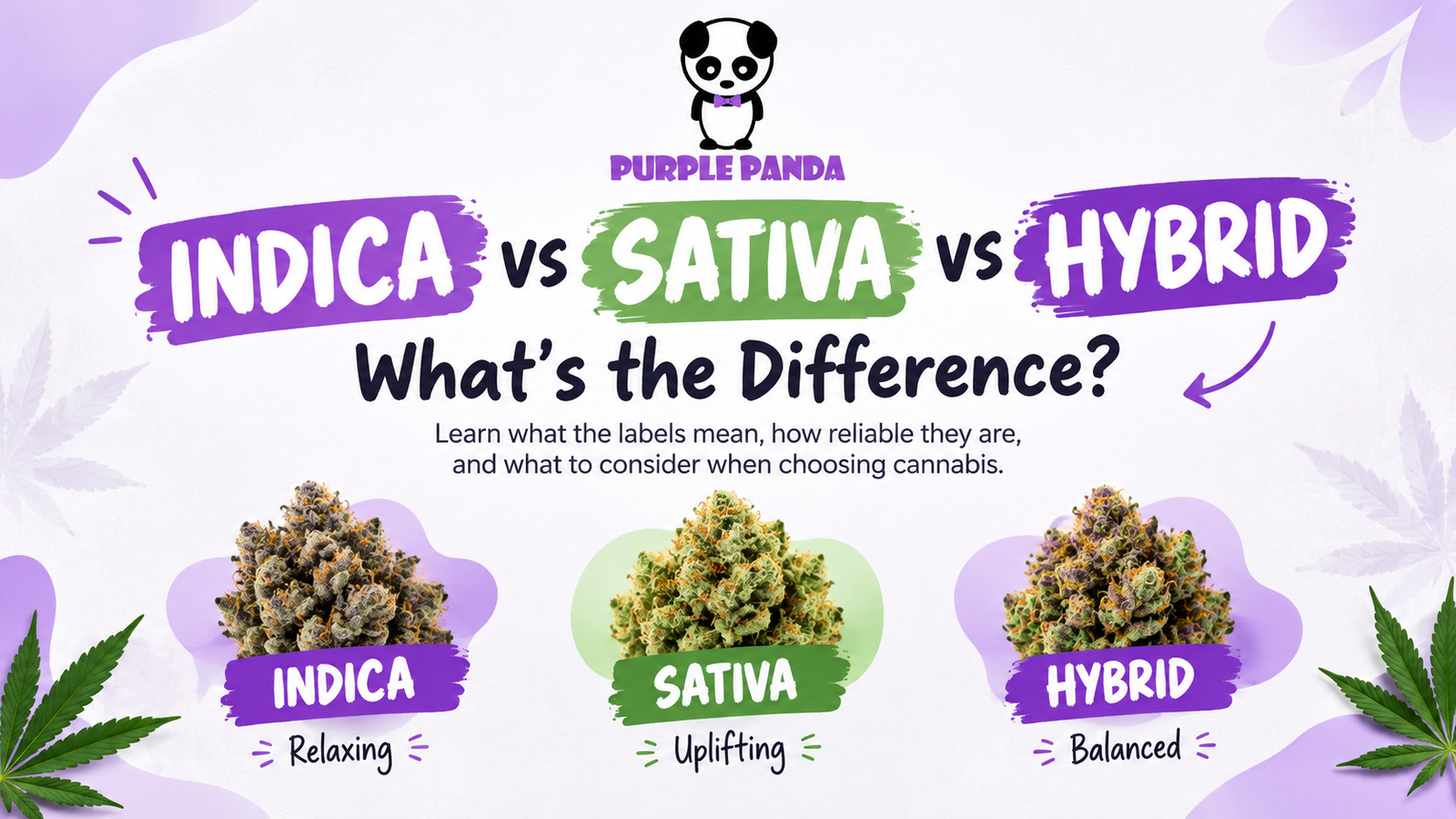
Indica vs Sativa vs Hybrid: How to Choose What’s Right for You
You're looking at a menu. Everything is sorted into three buckets: indica, sativa, hybrid. And somewhere along the way you've absorbed the idea that indica is the heavy one and sativa is the awake one. So which do you pick?
Here's the honest answer, and it's not the one most cannabis sites will give you. The indica vs sativa vs hybrid label is a rough steer, not a rule. It's useful. It's also weaker than the industry lets on, and knowing exactly how weak it is will make you a much better shopper.
This guide covers what the three labels actually mean, what the research says about how far you can trust them, and, more usefully, what to look at instead when you're deciding what to order.
You must be 19+ to purchase cannabis in Ontario.
The short answer
Indica is typically marketed as the heavier, evening option. Sativa as the brighter, daytime one. Hybrid is a cross of both, and it's what most modern cannabis genetically is.
But large-scale chemical testing has repeatedly found that products sharing a label often don't share a chemistry. A 2022 analysis of 89,923 cannabis samples, the biggest of its kind, concluded that an indica-labelled sample will likely have a terpene composition indistinguishable from a sativa- or hybrid-labelled one.
So use the label as a starting filter. Then narrow it down by aroma, THC content, and how much you plan to take. Those will tell you far more about your experience than the word on the jar.
What "indica" usually means
The name goes back to the late 1700s, when French naturalist Jean-Baptiste Lamarck described Cannabis indica as distinct from the already-named Cannabis sativa. Crucially, he was describing what the plant looked like, shorter and bushier with broader leaves, not what it did to anyone.
The "indica = relaxing" association came much later, from retail, not botany.
What people commonly describe: indica-labelled flower is most often reported as heavier and more physically settling. It's the kind of thing people reach for later in the evening, at home, with nothing scheduled afterward. Words that come up a lot in user reports are "sluggish" and "slow."
Is there anything behind that? A little. A 2023 study followed 101 regular users for two weeks, having them report on their phone within 30 minutes of actually smoking. Indica-dominant products were significantly linked to low-arousal effects. It's a small, preliminary study and the researchers themselves asked for it to be replicated in a lab. But it's real evidence, and it's fair to say the label isn't pure fiction.
There's also a chemical thread. Indica-labelled products tend to contain more myrcene, an aromatic compound often described as earthy and musky, which researchers have long associated with heavier, more sedate effects.
Browse the indica options in stock if that's the direction you're leaning.
What "sativa" usually means
Same origin story, opposite end. Taller plant, narrower leaves, and, in modern retail language, the daytime pick.
What people commonly describe: sativa-labelled flower is more often reported as brighter and more mentally active. It's what gets picked for daytime, for company, for doing something rather than nothing.
How much can you trust it? Less than you'd hope. When researchers grouped almost 90,000 samples by their actual chemistry, three natural families emerged:
| Chemical family | Dominant terpenes | Share of market |
| Family 1 | Caryophyllene + limonene | 61.8% |
| Family 2 | Myrcene + pinene | 25.6% |
| Family 3 | Terpinolene + myrcene | 12.6% |
Only the third and smallest family showed any real skew toward "sativa" labels. The other two, 87% of everything tested, didn't line up with the labels at all.
Take a look at the sativa options if you want the daytime lean.
What "hybrid" means, and why nearly everything is one
This is the part most guides get wrong, so it's worth being precise.
Genetically, almost all modern commercial cannabis is a hybrid. Decades of crossbreeding mean the clean lineages are essentially gone from the legal market. That includes the products sitting under an "indica" or "sativa" heading. When Dalhousie University researchers ran genome-wide analysis on cannabis samples in 2021, they found that strains labelled indica were frequently just as genetically close to sativa-labelled strains as they were to other indicas.
So what does the shelf label actually tell you? Which side the grower thinks the cross leans toward. That's it. It's a lean, not a species.
You'll see three versions of it:
- Indica-dominant hybrid: leans heavy
- Sativa-dominant hybrid: leans bright
- Balanced hybrid: roughly 50/50, and often the sensible pick when you're not sure
Our hybrids sit across all three of those leans.
Why the labels are a starting point, not a rule
Two findings make this concrete.
One. In 2021, researchers at Dalhousie published genome-wide and chemical analysis of cannabis samples in Nature Plants. Their conclusion, in their own words: "The 'sativa–indica' scale currently used to label cannabis poorly captures overall genomic and metabolomic variation." The label explained only about a tenth of the genetic variation between samples.
Two. The 2022 study of 89,923 samples put it more bluntly, calling the marketing of indica as sedating and sativa as energising "specious given our analysis of the underlying chemistry."
And then there's the anecdote that says it best. The strain AK-47 won the Sativa Cup in 1999, and the Indica Cup in 2003. Same strain. Opposite category. Four years apart.
Dr. Ethan Russo, a neurologist and one of the most cited researchers in the field, has been saying this for a decade: "One cannot in any way currently guess the biochemical content of a given Cannabis plant based on its height, branching, or leaf morphology."
None of this means the categories are useless. It means they're the first filter, not the last word.
What actually shapes the experience
If not the label, then what? Four things, in roughly this order of usefulness.
1. How much you take
This is the big one, and it's the one shoppers most consistently underrate. Health Canada's guidance for inhaled cannabis is to start with one or two puffs, then wait. Effects from smoking or vaping begin within seconds to minutes and reach full strength within about 30 minutes. Take one more puff at the 20-minute mark if you want to. You can always add, you can't subtract.
2. Aroma
This is the most practical trick in this whole guide. A study spanning 887 cannabis varieties and over 100,000 user reviews found that the aroma people reported lined up meaningfully with the effects they reported. Citrus, lime, pineapple and tropical notes clustered with stimulating descriptions like "creative" and "energetic." Earthy and berry notes clustered with the more soothing ones. The researchers concluded that flavour perception "could represent a reliable marker" for characterising effects.
Practical version: open the jar and smell it. Bright, citrusy, piney leans up. Earthy, musky, sweet-berry leans heavy. That will steer you better than the category heading above it.
3. THC percentage, with a caveat
Ontario's dried flower averages around 22% THC, and the great majority of products sit above 20%. Health Canada suggests 10% or less for people newer to cannabis, which is genuinely hard to find on any Canadian shelf. So the realistic move is to manage quantity, not chase a low percentage.
It's also worth knowing that potency doesn't scale the way people assume. In a study, participants using products several times stronger in THC ended up with roughly double the THC in their bloodstream, and reported feeling about equally highTerpenes are the aromatic compounds behind that jar smell: myrcene, limonene, caryophyllene, pinene, terpinolene. They're the leading explanation for why two products with near-identical THC can feel different. The "entourage effect" theory holds that these compounds shape the experience together with THC, rather than THC acting alone.
Worth being straight with you: that theory is not settled. A 2020 pharmacology study tested five common cannabis terpenes and found no evidence they act directly on the same receptors THC does. Terpenes clearly matter to aroma and correlate with reported experience. The mechanism is still being worked out.
Choosing by time of day and setting
| When | Typical lean | Practical note |
| Morning / daytime | Sativa or sativa-dominant hybrid | Citrus and pine aromas; go light on quantity |
| Afternoon / social | Balanced hybrid | The safest pick when the evening might go either way |
| Evening / at home | Indica or indica-dominant hybrid | Earthy, musky aromas; nothing scheduled after |
Treat this as a convention, not a prescription. Plenty of people find their own response runs opposite to the chart, and that's expected, given what the research says about the labels.
Choosing by experience level
If it's your first time. Start with a balanced hybrid, buy the smallest quantity available, and follow the one-or-two-puffs rule. Wait a full 20 to 30 minutes before deciding whether you want more. Have somewhere comfortable to be and no obligations after.
If you use occasionally. You're in the majority. 56% of Canadian cannabis consumers use three days a month or less. Tolerance fades between sessions, so an amount you handled comfortably a few months ago can land harder than you expect. The label matters less to you than the amount does.
If you have a regular tolerance. You already know your own patterns better than any category page does. This is where aroma and terpene profile become genuinely worth paying attention to, because you have the baseline to notice the difference.
How the star rating interacts with strain type
You'll see our flower graded from 2★ to 5★. That grade is about quality, meaning cure, trim, density, appearance and freshness. It is not about direction of effect.
A 3★ indica and a 5★ indica are both indicas. The 5★ is the better-grown, better-cured version of that experience, not a heavier one. The two systems answer different questions. is a rough steer on character. is a straight read on quality. Choose the type first, then choose your grade based on budget.
What to order first
- Not sure at all? A balanced hybrid, smallest quantity, 2★ to 3★ to keep the first spend low.
- Want the daytime lean? A sativa-dominant option with citrus or pine notes in the description.
- Want the evening lean? An indica-dominant option with earthy or musky notes.
Whichever you pick, buy small the first time. You learn more from three different small purchases than from one large one, and everything is delivered same-day across KW anyway, so there's no reason to over-order.
Know what you're after? Explore our indica flower, sativa strains, and hybrid options in stock.
Frequently asked questions
Is indica or sativa better for beginners?
Neither label reliably predicts your experience, so it isn't the right question to start with. What matters far more for a first time ordering is quantity. Health Canada suggests one or two puffs, then waiting to see how you feel. A balanced hybrid is a reasonable default.
Can you actually feel the difference between indica and sativa?
Sometimes, but not dependably. A 2023 real-world study of 101 users did find indica-labelled flower was more often reported as sluggish or slow. But large-scale chemical analysis finds that indica- and sativa-labelled products frequently have indistinguishable terpene profiles, so the label alone is a weak predictor.
What does "indica-dominant hybrid" mean?
Nearly all commercial cannabis today is a genetic cross. "Indica-dominant" describes which parent side the grower considers dominant in that cross. It's a lean, not a species. Sativa-dominant and balanced hybrids work the same way.
Does a higher THC percentage mean a stronger high?
Not proportionally. In a study, people using products several times stronger in THC ended up with roughly double the blood THC, and still reported feeling about equally high. Quantity and tolerance shape your experience more than the number on the label.
Which type should I order if I'm not sure?
A balanced hybrid, in the smallest quantity available. Then use aroma to steer your next order. Brighter citrus and pine notes tend to be described as more uplifting, earthy and musky notes as heavier.