 💥‼️WE'RE BACK IN KITCHENER AND DOING SAME DAY DELIVERIES‼️💥
🤑💵 CONTACT US FOR OUR NEW E-TRANSFER EMAIL 💵🤑
Posted on : Wednesday September 2, 2026
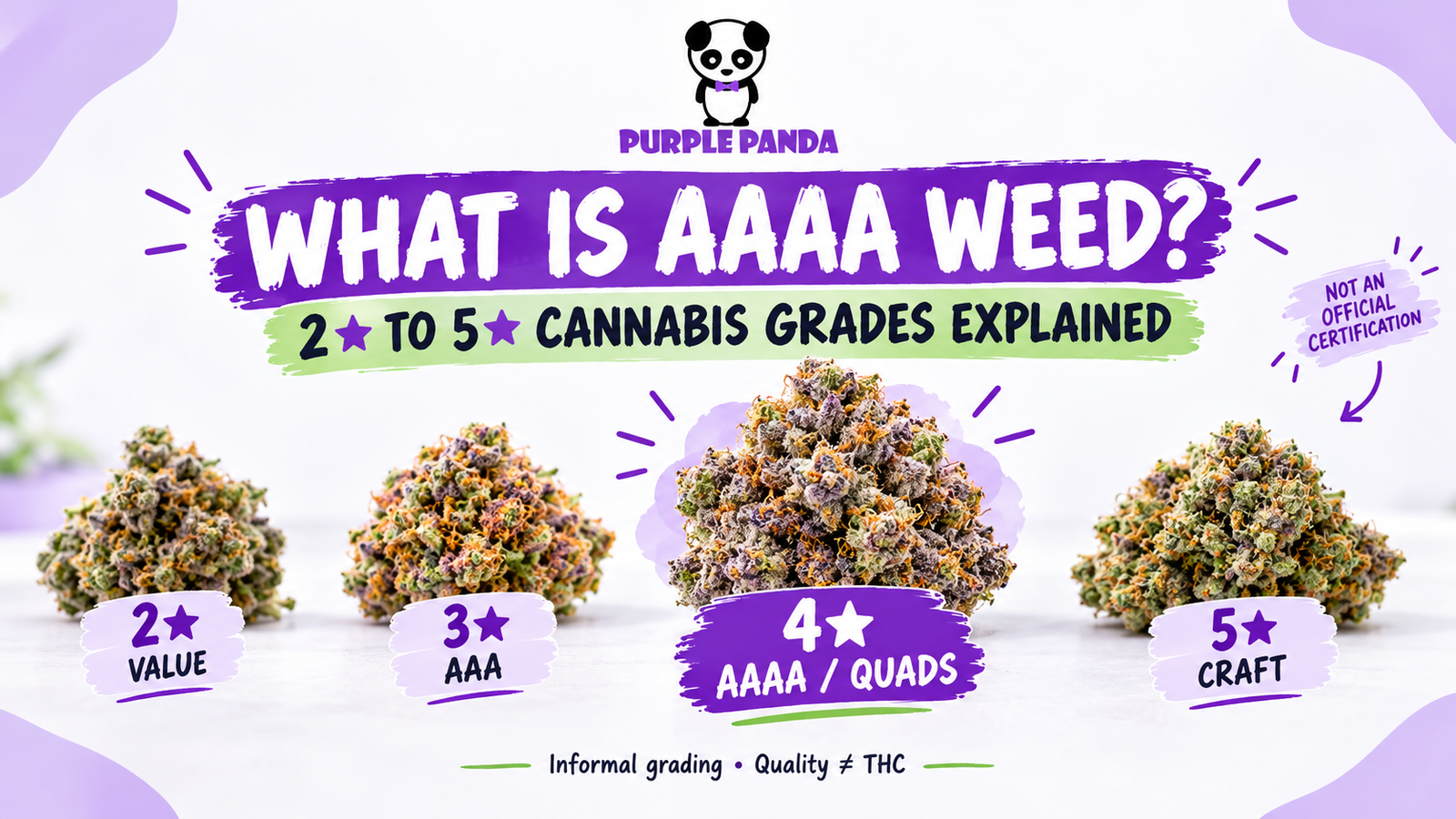
What the Star Ratings Mean: 2★ to 5★ Weed Explained
You're comparing two jars. One is 3★, one is 5★, and the second costs noticeably more. What exactly are you paying for?
This guide answers that: where the star system came from, what separates one tier from the next, and the part most sellers skip. Nobody regulates any of it. There is no Canadian standard for cannabis grading. The whole thing is a convention the industry agreed on among itself.
That doesn't make grades useless. It means you should know how to read them, and which signals hold up when the letters don't.
You must be 19+ to purchase cannabis in Ontario.
The short answer
AAAA weed, often called "quads," is the top-shelf tier in Canada's informal A-to-AAAA grading convention. Purple Panda uses stars for the same idea: 2★ is value flower, 5★ is craft. Grade reflects how the flower was grown, dried, cured and trimmed, not how strong it is.
Health Canada regulates testing, labelling and safety. It does not define grades. So a 4★ at one seller and a 4★ at another are two people's opinions, not two measurements.
Where the Star System Comes From
Canada's grading vocabulary predates legalisation. It grew out of the legacy market, where sellers needed shorthand for quality and no lab reports existed. The convention runs A, AA, AAA, AAAA, with some sellers adding AAAAA or "AAAA+" above that.
Two things follow from that history.
It was never written down by anyone official. Search for the definitive Canadian weed grading standard and you'll find dispensary blog posts, each with slightly different tier definitions. There's no governing document because there's no governing body.
Stars and letters are the same system. 4★ means AAAA means quads. Same tier, three names.
What Is AAAA Weed?
AAAA, or "quads," describes flower at the top of the conventional scale. A seller applies it to flower showing dense, well-formed buds, visible trichome coverage, a strong and distinct aroma, a careful trim and a proper cure.
Above it you'll see AAAAA and "AAAA+" used for small-batch craft product, which is what 5 star weed usually means in practice. Our craft and top-shelf selection uses the AAAAA+ language for hand-selected BC craft flower.
Worth knowing: the tiers above AAAA are the least consistent part of the convention. If AAAA is a loose agreement, AAAAA is barely an agreement at all. Judge those by the grower and the description, not by the count of As.
The Star Scale, Tier by Tier
| Stars | Letter Grade | What It Usually Reflects | Typically Suits |
| 2★ | AA | Budget flower. Looser bud structure, lighter aroma, often machine trimmed | Volume buying, cooking, keeping costs down |
| 3★ | AAA | Solid mid-shelf. Decent structure and aroma, no obvious faults | Everyday use |
| 4★ | AAAA (quads) | Top-shelf. Dense buds, strong nose, good trim, proper cure | Most buyers, most of the time |
| 5★ | AAAA+ / craft | Small-batch, usually hand-trimmed, slow-cured | Occasion buying |
Browse our 5★ shelf to see the top tier, or 3★ value flower if you're buying for everyday use.
What Actually Drives a Grade
Five things separate a 3★ from a 5★. Only some of them are visible in a photo.
Cure, Which Matters Most
Curing is the slow, controlled drying after harvest, and it's where most quality is won or lost. The industry measures it by water activity, a reading of how much free moisture the flower holds. The accepted target for cured cannabis is 0.55 to 0.62 aw, and there's a technical standard for measuring it: ASTM D8196.
- Above 0.65 aw, mould becomes possible. That's the recognised safety ceiling.
- Below the range, flower is over-dried. Trichomes turn brittle and break off, terpenes evaporate, smoke turns harsh.
A rushed cure is the most common reason good genetics arrive as mediocre flower.
Trim
Hand trimming removes excess leaf without knocking trichomes off the bud. Machine trimming is faster, cheaper and rougher on the surface of the flower. Trim is one of the clearest dividing lines between tiers.
Bud Structure and Aroma
Dense, well-formed buds usually mean good light, good airflow and the right harvest timing. Loose, airy bud often means the opposite.
Aroma matters just as much. A strong, layered smell says terpenes survived the dry and cure. A faint or hay-like smell says they didn't. This is the most useful thing you can assess yourself, and most buyers underuse it.
Bag Appeal, Which Is the Least Reliable Signal
Frosty-looking flower sells. But a 2025 review in the journal Plants examined trichome density and concluded that "higher density alone does not guarantee greater cannabinoid potency." Shape, size and maturity all matter, and visual density on its own does not track chemical content.
Attractive flower is a reasonable sign that care was taken. It is not a measurement of anything.
Grading Is a Convention, Not a Standard
This is the part worth understanding properly, because it changes how you shop.
What Health Canada actually regulates. Licensed producers must test every lot for cannabinoids and contaminants including pesticides, heavy metals and microbial content. Every lot needs sign-off from a designated Quality Assurance Person before sale. THC and CBD figures must reflect that lot's own test results, not historical values for the strain. Net weight carries published tolerance limits: 10% for packages up to 2 grams, 5% above that.
What it does not regulate. Grades. Health Canada's Good Production Practices guide covers sanitation, testing, storage and quality assurance, and contains no definition of a flower grade at all. No stars, no letters, no tiers.
So one seller's 4★ can be another seller's 5★, and neither is breaking a rule. Grading is a claim made by whoever is selling you the flower.
Protecting yourself is simple: treat the grade as the seller's summary and check it against the product. Look at the trim. Smell it. Feel whether it's spongy or brittle. Those are direct observations. The star is a secondhand one.
Does a Higher Grade Mean Higher THC?
No, and this is the most expensive misunderstanding in the category.
Grade is about cultivation and post-harvest care. Potency is a lab number. They correlate loosely at best, because a well-cured 3★ can easily test higher than a poorly handled 5★.
Two further reasons not to shop by the THC figure.
Labelled THC is frequently overstated. A 2023 study in PLOS ONE tested 23 samples across 10 dispensaries and found roughly 70% came in more than 15% below their label claim, with measured THC averaging about 15% against label claims of 20% to 24%. A larger 2025 study in Scientific Reports tested 277 products from 52 dispensaries and found only 56.7% of flower products landed within 15% of the labelled figure. Concentrates did far better at 96%. In both studies the error ran the same direction: actual potency came in lower than the label.
Higher THC doesn't reliably buy a stronger experience. In a JAMA Psychiatry study, people using products several times stronger in THC ended up with roughly double the THC in their bloodstream and reported feeling about equally high.
Consumers still pay for the number anyway. Market data from July 2025 found higher-potency flower carried roughly an 8% price premium per eighth. You don't have to participate in that.
Grade also tells you nothing about strain type. Indica, sativa and hybrid all come in every tier, which is a separate question covered in our guide to choosing between indica, sativa and hybrid.
Which Tier Suits Which Buyer
Buying on a budget. 2★ and 3★ do the job. Value flower is less pretty and lighter in aroma, but a well-cured 3★ is a perfectly good smoke. For edibles or infusions, paying for bag appeal makes no sense at all, since appearance stops mattering the moment it's decarbed.
Everyday use. 3★ to 4★ is where most regular buyers settle. 4★ is the tier where trim, structure and aroma reliably show up together.
Buying for an occasion. 5★ earns its place when the flower itself is the point: the smell when the jar opens, the smoothness, the presentation.
New with no reference point. Start at 3★ or 4★, smallest quantity, and pay attention to what you notice. You can't evaluate a 5★ without something to compare it to, and building that reference cheaply beats starting at the top.
How Grade Affects Price Per Gram
The 3★ to 4★ step is usually the biggest jump. That's where hand trimming, longer cures and tighter selection enter the cost base. For most people it's also the step that delivers the clearest improvement.
The 4★ to 5★ step costs more for a subtler difference. You're paying for small-batch production and refinement. Real, but heavily dependent on whether those qualities matter to you.
One practical note: buying more of a lower tier plus a little of a higher tier often beats spending the same money in the middle. You get everyday supply and something better for when it counts.
Frequently Asked Questions
What is AAAA weed?
AAAA, or "quads," is the top standard tier in Canada's informal grading convention, equivalent to 4★. It describes flower with dense buds, visible trichome coverage, strong aroma, careful trim and a proper cure. It is a seller's quality claim, not a regulated classification.
Is 5★ weed stronger than 3★ weed?
Not necessarily. Grade reflects growing and curing quality, not THC content. A well-cured 3★ can test higher than a poorly handled 5★. Potency comes from the lab result, and even that is often overstated on labels.
What's the difference between AAA and AAAA weed?
AAA is solid mid-shelf with no obvious faults. AAAA is top-shelf, where denser structure, stronger aroma, better trim and a more careful cure all appear together. This is typically the biggest quality step and the biggest price step on the scale.
Is 2★ weed bad?
No, it's budget flower. Expect looser structure and lighter aroma. For volume buying, or for cooking and infusions where appearance doesn't matter, it can be the sensible choice.
Who decides the grade?
The seller. There is no Canadian regulator, standards body or certification behind cannabis grading. Health Canada mandates testing and labelling accuracy, not grades. That's exactly why it's worth checking the flower yourself rather than trusting the star alone.
Store Hours
Mon : 10am-8pm
Tue : 10am-8pm
Wed : 10am-8pm
Thu : 10am-8pm
Fri : 10am-8pm
Sat : 10am-8pm
SUNDAY IS CLOSED